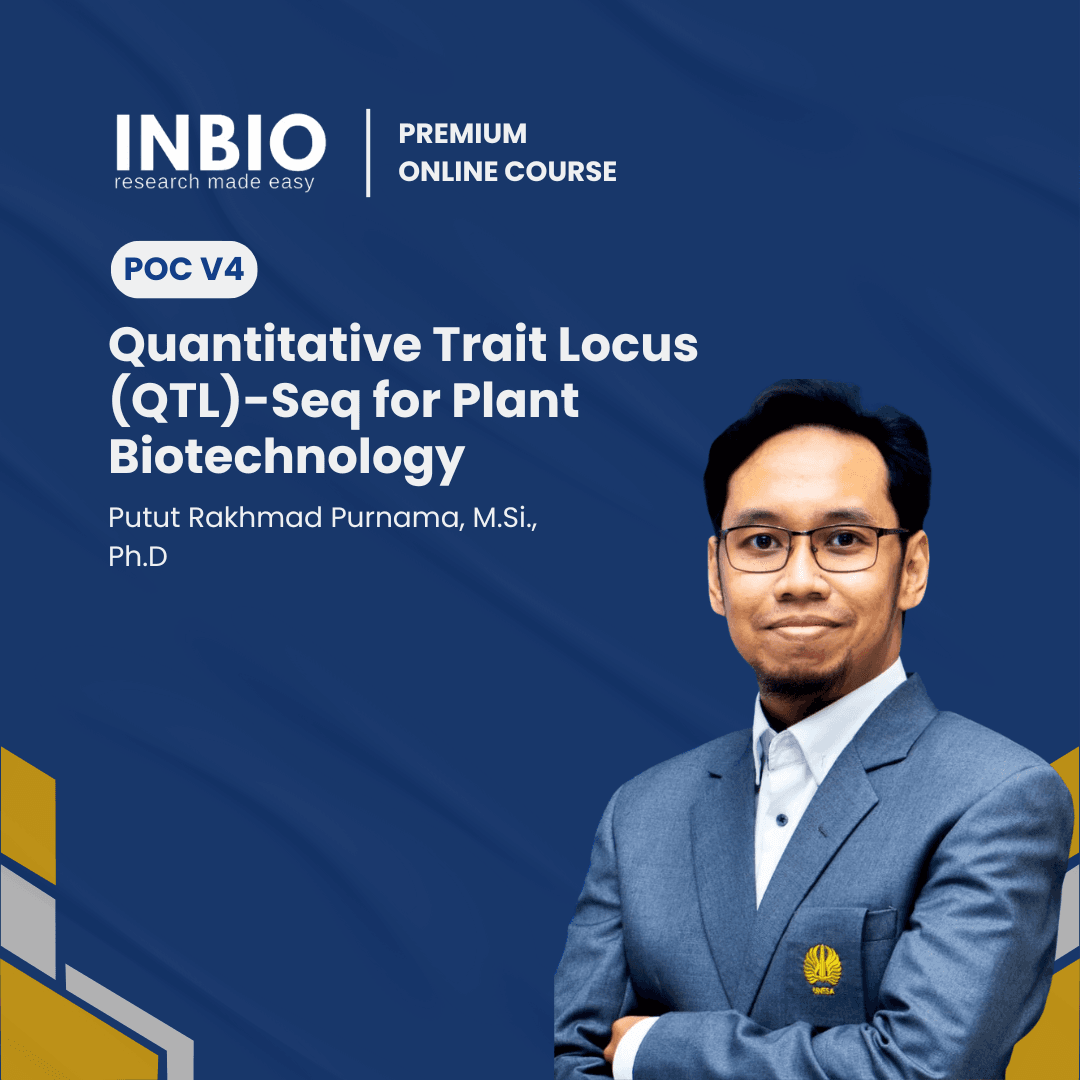
Quantitative Trait Locus (QTL)-Seq for Plant Biotechnology
Putut Rakhmad Purnama, M.Si., Ph.D



Course Overview
This course introduces participants to QTL-seq, a powerful next-generation sequencing approach for identifying genomic regions associated with complex traits in plants. It is designed for researchers and students interested in plant genetics, genomics, and crop improvement. The course begins with an overview of QTL-seq principles, followed by detailed guidance on experimental design and workflow planning. Participants will learn key concepts and steps involved in QTL-seq analysis, including sequencing strategies, bulking, and statistical interpretation. Through case studies, learners will explore real-world applications of QTL-seq in plant biotechnology. A hands-on session will provide step-by-step guidance on performing QTL-seq analysis using the QTLseqr package in R. Participants will work with sample datasets, perform analysis, and interpret the results in a biological context. This course is ideal for plant biologists, geneticists, and bioinformaticians aiming to integrate QTL mapping into their research. Familiarity with basic R programming and plant genetics is recommended. This course introduces participants to QTL-seq, a powerful next-generation sequencing approach for identifying genomic regions associated with complex traits in plants. It is designed for researchers and students interested in plant genetics, genomics, and crop improvement. The course begins with an overview of QTL-seq principles, followed by detailed guidance on experimental design and workflow planning. Participants will learn key concepts and steps involved in QTL-seq analysis, including sequencing strategies, bulking, and statistical interpretation. Through case studies, learners will explore real-world applications of QTL-seq in plant biotechnology. A hands-on session will provide step-by-step guidance on performing QTL-seq analysis using the QTLseqr package in R. Participants will work with sample datasets, perform analysis, and interpret the results in a biological context. This course is ideal for plant biologists, geneticists, and bioinformaticians aiming to integrate QTL mapping into their research. Familiarity with basic R programming and plant genetics is recommended.
Sub-topics
- 1.Introduction to QTL-seq
- 2.Experimental Design & Workflow
- 3.QTL-seq Pipeline and Key Concepts
- 4.Case Studies & Applications
- 5.Hands-on: Introduction to Hands-On Dataset and Setup, Step-by-Step QTL-seq Analysis using QTLseqr, Result Interpretation and Discussion
Course Components
-